In the manufacturing industry, hot pressing machines play a pivotal role in numerous production processes. As a hot pressing machine vendor, I’ve witnessed firsthand how the quality of mold design can significantly impact the performance and efficiency of these machines. The significance of mold design for a hot pressing machine extends far beyond mere physical compatibility; it involves considerations of material properties, production efficiency, and quality control. In this blog, I will delve into the multiple dimensions of why mold design is crucial for hot pressing machines. Hot Pressing Machine

Ensuring Product Quality
One of the most straightforward reasons for the importance of mold design is its direct influence on product quality. A well – designed mold ensures that the product produced by the hot pressing machine has accurate dimensions and a smooth surface finish. During the hot pressing process, the mold exerts pressure and heat on the material, shaping it into the desired form. Any imperfection in the mold design, such as uneven wall thickness or rough internal surfaces, can be directly transferred to the final product.
For example, in the production of composite materials using a hot pressing machine, a precisely designed mold can ensure uniform distribution of pressure and heat across the material. This uniform application is vital for achieving consistent mechanical properties throughout the product. If the mold design is faulty, areas of the composite may receive more pressure or heat than others, resulting in regions of varying density and strength. These inconsistencies can compromise the structural integrity of the final product, making it less reliable and potentially unsafe for its intended use.
Moreover, a high – quality mold design can reduce the occurrence of defects such as flash, sink marks, and warping. Flash occurs when excess material squeezes out between the mold halves during the hot pressing process. A well – fitting mold with tight clearances can prevent this issue, reducing the need for post – processing to remove the flash. Sink marks, which appear as depressions on the surface of the product, are often caused by uneven cooling or pressure distribution during solidification. By optimizing the mold design to ensure uniform cooling channels and proper venting, the likelihood of sink marks can be minimized. Warping, which is the distortion of the product’s shape after it is removed from the mold, can also be mitigated through careful mold design that accounts for the material’s shrinkage characteristics during cooling.
Maximizing Production Efficiency
Efficiency is a key factor in any manufacturing operation, and mold design plays a critical role in optimizing the production process of a hot pressing machine. A well – designed mold can significantly reduce cycle times, which is the time required to complete one production cycle.
The layout of the mold cavities is of utmost importance. A multi – cavity mold design allows multiple products to be produced simultaneously in a single hot pressing cycle. This can greatly increase the production output per hour, reducing the overall production time and cost. However, designing a multi – cavity mold requires careful consideration of factors such as material flow, pressure distribution, and cooling. If these factors are not properly addressed, some cavities may produce defective products while others produce good – quality ones, leading to inefficiencies and increased waste.
In addition to the cavity layout, the design of the mold’s gating system also affects production efficiency. The gating system is responsible for guiding the molten material into the mold cavities. A well – designed gating system ensures that the material fills the cavities evenly and quickly. It should minimize the pressure drop during filling to prevent incomplete filling or the formation of air bubbles. By optimizing the gating system, the injection time can be reduced, and the quality of the filled product can be improved.
Furthermore, easy mold unloading is essential for efficient production. A mold designed with features such as ejection pins or slides in the right locations can facilitate the removal of the finished product from the mold. This reduces the time and effort required for manual unloading, enabling the hot pressing machine to start the next cycle more quickly.
Enhancing Material Compatibility
Different materials have different properties, such as melting points, viscosity, shrinkage rates, and chemical reactivity. A good mold design must take these material properties into account to ensure successful hot pressing operations.
When working with high – melting – point materials, the mold needs to be made of a material with high heat resistance and thermal conductivity. For example, when hot pressing metals or ceramics, molds made of tool steel or tungsten carbide may be required. These materials can withstand the high temperatures involved in the process without deforming or losing their structural integrity. At the same time, their good thermal conductivity helps to transfer heat to the material being pressed quickly and uniformly.
Viscosity is another important material property. Materials with high viscosity require a mold design that allows for sufficient pressure to be applied during the hot pressing process to ensure proper filling of the mold cavities. The gating system and the overall mold geometry need to be optimized to accommodate the flow characteristics of the viscous material. If the mold is not designed to handle high – viscosity materials, incomplete filling or the formation of weld lines may occur, leading to poor – quality products.
Shrinkage rate is a critical factor in mold design as well. Different materials shrink at different rates during cooling after hot pressing. If the mold is not designed with the appropriate allowances for shrinkage, the finished product may be smaller than the desired dimensions. A well – designed mold will compensate for the shrinkage of the material, ensuring that the final product meets the required specifications.
Chemical reactivity is also a consideration, especially when pressing materials that are corrosive or reactive with certain metals. In such cases, the mold may need to be coated with a protective layer or made of a non – reactive material to prevent damage to the mold and contamination of the product.
Facilitating Maintenance and Cost – Effectiveness
Proper mold design can also simplify maintenance procedures and reduce long – term costs. A well – constructed mold is easier to disassemble, clean, and repair. It is designed with access points for maintenance tasks, such as ports for cleaning the cooling channels or removable sections for replacing worn – out components.
Additionally, a high – quality mold design can extend the service life of the mold. By using materials with good wear resistance and designing the mold to withstand the stresses of the hot pressing process, the frequency of mold replacement can be reduced. This not only saves on the cost of purchasing new molds but also reduces the downtime associated with mold replacement, allowing the hot pressing machine to operate more continuously.
Furthermore, efficient mold design can contribute to cost savings in terms of energy consumption. A mold that is designed to ensure uniform heat distribution and efficient material flow requires less energy to operate. For example, a mold with well – designed cooling channels can cool the product more quickly, reducing the overall cycle time and the amount of energy used for heating and cooling.
Conclusion
In conclusion, the importance of mold design for a hot pressing machine cannot be overstated. It is a key determinant of product quality, production efficiency, material compatibility, and cost – effectiveness. As a hot pressing machine supplier, I understand that a well – designed mold is an indispensable part of a high – performing hot pressing system.
If you are in the market for a hot pressing machine or need to optimize your existing production process, the mold design is a critical factor that you should not overlook. We are dedicated to providing comprehensive solutions that include both high – quality hot pressing machines and expertly designed molds. Our team of experienced engineers can work with you to understand your specific requirements and develop customized mold designs that meet the highest standards.
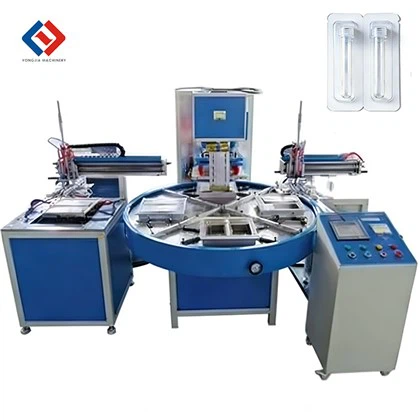
If you are interested in learning more about our hot pressing machines and mold design services, or if you have any questions regarding your production needs, we encourage you to reach out to our sales team for a detailed discussion. We are eager to help you improve your manufacturing process and achieve better results.
C Type Welding Machine References
- "Mold Design Handbook" – Comprehensive guidelines on mold design principles and practices.
- "Hot Pressing Technology: Fundamentals and Applications" – Covers the basic concepts and practical applications of hot pressing machines.
- "Materials Science in Manufacturing" – Explains the relationship between material properties and mold design in manufacturing processes.
Dongguan Yongjia Machinery Equipment Co., Ltd.
We are one of the most reliable hot pressing machine manufacturers and suppliers in China, specialized in providing high quality customized service. Please feel free to wholesale advanced hot pressing machine at low price from our factory. For quotation, contact us now.
Address: No. 240, Chashan South Road, Chashan Town, Dongguan City, Guangdong Province, China
E-mail: info@yjwelding.com
WebSite: https://www.yjhighfrequencymachine.com/
